
Watching Michael (2026) triggered me
A reflection on cognitive dissonance and voluntary amnesia

Everyone has a tale about Michael Jackson. For some, it’s listening to his infectious music for the first time and the joy Smooth Criminal or Thriller brought them. Or seeing him moonwalk effortlessly. My mother, heavily pregnant at the time, recalls watching the King of Pop during his 1988 Bad tour at Wembley. My anecdote is when Jackson attended a mundane football match between Fulham and Wigan Athletic. That was in 1999 and twelve years later, after the singer’s death, Fulham built a statue of Jackson outside their stadium.
The sculpture was commissioned by the club’s chairman and Michael’s friend, Mohamed Al-Fayed. Over the past few years the late former owner of Harrods has faced posthumous allegations of sexual abuse and assault from hundreds of his former employees. Michael certainly knew how to pick his company.
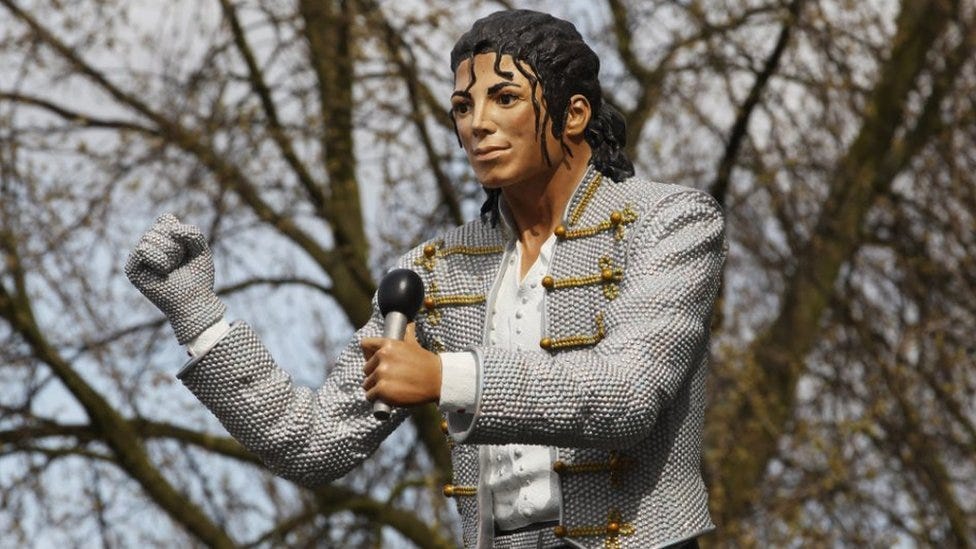
You can’t see this statue any more. It had a few homes but following the release of Leaving Neverland in 2019, where sexual abuse allegations were made against Jackson, it was quietly dismantled.
Why should we care about this story and other shady details that seemed to gravitate towards Jackson; we’re here to watch Michael. Still, it’s hard for us to reflect on the film without being distracted by such things. We’re human, after all.
However, it’s this use of the we that’s most menacing. We is passive. It’s loose and easily escaped. It doesn’t hold us to account. What about: why should I care? Or, what should you think about such things? Look, Lloyd, I go to the movies to be entertained. Stop being so bloody serious for once. Not my circus, not my monkeys (even the CGI one).
Michael is less a film and more a dystopian future where Spotify has an AI button to create a movie based on a playlist. One where artists - or their opportunistic estates - can control narratives. Chapter one of Jackson’s life is forced down our throats: that’s just who he was. He was different. I wonder if small details like his lack of eye contact as a child or asking his adult brothers to play Twister were a pitiable attempt to somehow justify why a grown man - who was 44 years of age at the time of admitting this - would openly confess to sharing his bed with children. That’s just how they are.
I’m not the only one wrestling with the movie. Spare a thought for Colman Domingo. A talented Oscar-nominated actor whose portfolio has many memorable performances. Sing Sing comes to mind. Here, Domingo turns heel as Michael’s tyrannical father, overselling every scene like an ageing WWE star and taking the back-breaking punishment for the mediocrity around him. All to keep the show going. Michael is a story of remember when and has no interest in interrogating any of the uncomfortable aspects of Michael Jackson’s character. All Jekyll and no Hyde.
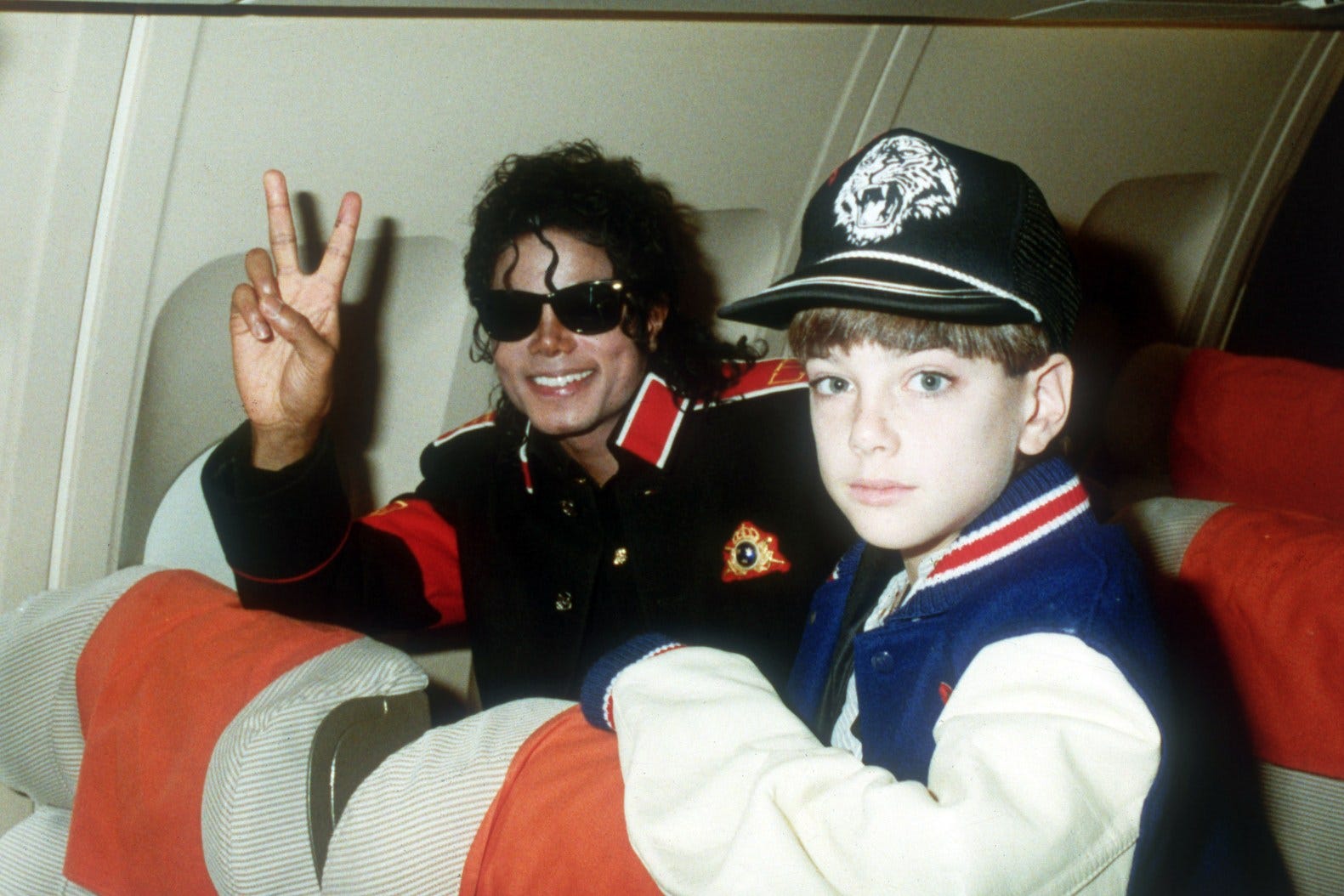
It’s not my aim to engage in any form of self-righteousness either. The music is punchy, high-voltage and massive. Whether I want to or not, my legs tap as Thriller and Wanna Be Startin’ Somethin’ play. Nevertheless, there’s a dissonant wave present when the songs boom out of the speakers - invisible to the eye but clear in the heart - that is anti-immersive. This sensation presents itself more when listening to his music because the film itself is nothing. A confused dream that doesn’t ask anything at all. It wouldn’t be so bad if it didn’t try to hide any of the wrongs that Jackson’s was accused of. It’s trying to make fools of us all.
I have a hunch I’m not the only one who experiences this cognitive dissonance after watching Michael or listening to his music again. A raft of film reviews are also flip-flopping around the topic which can be paraphrased into: the movie doesn’t cover the other stuff so we’ll save for another time. Or my favourite of them all: I can separate the art from the artist. I’m unsure if this is some sort of pseudo-intellectual stance or a mechanism to shut down thought.
Reading commentary, criticism, and general discourse has felt like an experiment on biases, rationalisation and defence mechanisms. All, I think, to continue enjoying art without feeling any internal moral conflict. But, again, I argue that even a small thought or feeling is itself enough to distract from the experience. Michael Jackson made people giddy. Giddy enough to let their children share bedrooms with the man. Giddy enough for some to engage in voluntary amnesia.
Maybe I should just stop with this frippery. I’m ever so sure, should there be a second movie, it will tackle these accusations head-on. I should just get on with it and stop being so sensitive. Stop overthinking. These are the kind of statements I’ve heard from people throughout my life. Even so, I’m content at being held in this restrictive tension from dissonance. I wouldn’t be so triggered if Michael at least tried to be anything other than a milking of the cash cow.
Let me repeat, I still listened to Bad on the way home from the cinema. So did a lot of people based on the record numbers of streams the artist is now publishing. Even Janet Jackson (whose absence from the film screamed there’s absolutely nothing to see here, folks) has seen all-time high numbers.
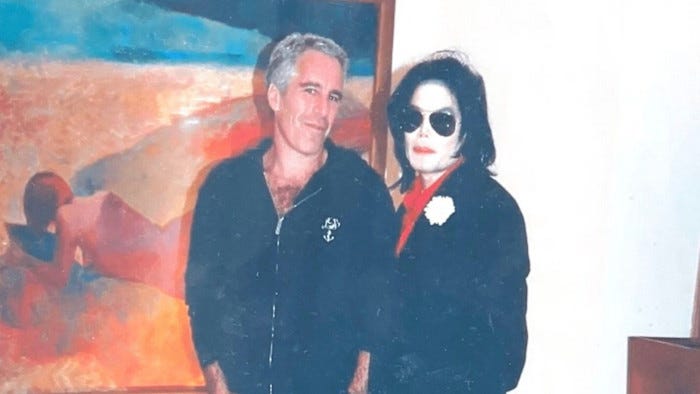
The most pertinent comment - or maybe normalisation and dismissal - on the film is how we witness Michael’s abuse from his father. He didn’t have a childhood. Two truths can exist but any justification, however soft, needs to be carefully considered. It’s merely a coincidence that during Michael’s release, King Charles’ visit with Donald Trump didn’t include any public discussions about his brother’s ties to Jeffrey Epstein. Meanwhile, we also have a picture of Epstein with Michael Jackson. Did Peter Pan and Captain Hook become mates?
I know, I know. A picture doesn’t tell us anything other than they had a picture together. It’s not really good for the brand though, is it? The sad reality is that victims of abuse know all too well that this is how it goes. Complicity can exist in silence. My mind jumps to one of the film’s most cringeworthy quotes from Michael, as he refuses to attend a TV interview (something he avoided throughout his career): I want to be mysterious. No shit. Maybe everyone knew the family secrets.
But there’s no coup de grâce here.
Just an acknowledgement that my dissonance exists.
This film is an authorized biography, made with endorsement of the Jackson estate in order to obtain approval to use Jackson's music. It was never going to be anything but a glowing hagiography. The sequel (and there certainly will be one) won't be allowed to delve into the child molestation accusations in anything but the most superficial terms, shrugging them off as, "Of course he didn't do it. Those are all lies by terrible blackmailers. Michael was a perfectly innocent angel."
Excellent essay. I have no desire to see this movie, yet I am rather consistently asked about it, since it seems to be very popular right now among young folks (and I work in education). The kids are fascinated when they are about to drop the truth on me — that he was abused! — and I tell them I know, because that was common knowledge about Joe Jackson, and it was already covered in other things, like an old TV miniseries about the Jacksons. This seems to be so bizarre to them, that this is not some unearthed never-before-seen info. No one before them ever even heard of Michael Jackson, and this movie shows he was the greatest performer of all time! I’ll give them this — the propaganda machine in this movie seems to be real slick, to rope a younger generation into buying a whole bunch of plastic bullshit.