
Spielberg's Disclosure Day Delivers
and Emily Blunt's jazzy performance steals the show


Steven Spielberg’s Disclosure Day (2026) releases in the context of American government publishing hundreds of files on UFOs and UAPs (an awkwardly pronounced acronym: Unidentified Anomalous Phenomena). The film plays on this anxious curiosity with a sense of realism because whilst his previous sci-fi works could be viewed as fantasy, we could now begin to imagine that a story such as this might be more than just make-believe. But rather than spending time on exploring if aliens really do exist, Spielberg interrogates the hidden and paranoid powers who control information through a cybersecurity lens, and the impact of these truths on humanity and established world order.
When a major release happens and discourse takes over, it’s easy to get lost in hyperbolic thinking and verbose phrases, as if excitement reduces oxygen supply to the brain and giddiness takes over the keyboard. But, without over-inflating, Emily Blunt is remarkable as Margaret (an intuitive Kansas weather presenter) as we’re introduced to her during one particularly peculiar morning, which culminates in her speaking a sort of babble during a live TV performance before collapsing. Blunt’s garbled sounds that overtake Margaret’s speech were recorded with sound editor Gary Rydstrom (reassuringly without AI), and we soon learn only one other person is able to understand this alien dialect, Daniel Kellner (Josh O’Connor, as an anxious and reluctant hero).
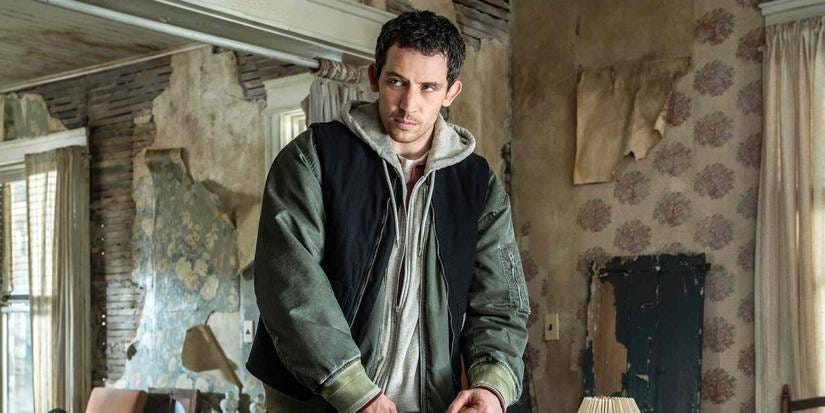
Blunt’s character conjures up memories of Roy Neary from Spielberg’s Close Encounters of the Third Kind (1977), but where Richard Dreyfuss’ character in that story seemed to jar and become entangled with the director’s childhood trauma, Margaret has a jazz-like quality to her; someone who can effortlessly flow, is easy to follow and never overplayed. Blunt has rhythm and a command of her emotional dials, moving up as she shows excitement or becomes enthralled (like scenes with her perplexed husband, Wyatt Russell, who brings a colourful humour) but can easily shift to anxious and neck-pulsating panic, namely in a moment with Kellner as they escape agents of Wardex (the non-government agency that is entrusted to protect against alien disclosures). If Margaret’s world is full of energy and vivid red colours, Kellner’s story is dark and grey like the clothes on his back and his empty hideout house as he evades the agency he works for with the help of his girlfriend, Jane (Eve Hewson), after stealing protected files from their database.
Kellner’s scenes show the conspiracy angle and Jane’s unwitting apprehension serves as a mirror for the audience, as she slowly learns about these new lifeforms before the camera nauseously spins around and encrypted footage reveals itself. Spielberg, as always, lets shots linger throughout and tense moments of build-up raise anxieties. As the story unfolds and their worlds merge, Margaret and Kellner are pulled together by some unknown outer force as visuals blend and Margaret’s beaming red dress is replaced with a bright yellow jumper that is largely covered by a grey coat. A visible sign the characters are closer than they think.
Disclosure Day explores a lot of themes, not just alien encounters. David Koepp’s script probes religious faith, and what discovery of new lifeforms could do for people’s fundamental views on life. Its conspiratory tone also deals with the handling of truth and questions of who controls this information, with Wardex and their leader Noah (Colin Firth almost convinces in his evil role) mirroring many cyber-intelligence agencies. Under the auspices of Noah, the agency reverse engineers alien technology that enables a sort of hypnotic transportation as we see when Noah tries to mind-control Jane to locate Kellner’s whereabouts, although the human brain can’t fully cope with the technology; a nod to similar concepts from Forbidden Planet (1956). There are a few plots with Noah that don’t always land, like his aggravation at Kellner’s defection from the agency, but overall the Wardex narrative elevates a sense of realism.
Communication is another topic in the story, from Margaret blurting out spontaneous Russian dialogue or her telepathically understanding people she encounters on her journey. Kellner’s ability to comprehend her alien dialect resonates with Spielberg’s earlier sci-fi films and Arrival (2016), where other similar themes of empathy and state paranoia drive actions. And John Williams’ score builds emotion throughout, from rising tension as Kellner and Margaret evade Wardex forces to a sentimental sound reminiscent of E.T. the Extra-Terrestrial (1982) as we learn about non-human contact, culminating in the paranoid anxiety of the final scenes as the truth is revealed. As the music plays near the end, a news reporter (an impressive cameo from Courtney Grace) portrays what it could be like to witness these disclosures whilst having to process everything in the moment. Grace balances emotion, fear and shock with due diligence as a mirror for anyone seeing this news for the first time. It’s a small moment in the film, but critical to the feeling of the finale.
It’s not without flaws, which is not unsurprising given the depth it covers, but Colman Domingo’s character as a rebellious leader from Wardex and guide for Kellner and Margaret feels underdeveloped, although Domingo’s calm and nurturing performance works well on-screen. The film explores various binary oppositions: freedom vs control when deciding who gets to tell the truth and what those consequences could be; order vs chaos once these truths are known, with symbolic visuals of the cross and questions of faith providing balance to the story. Disclosure Day will provoke thought and conversation about how close we are to realising we’re not alone as a species, and in the context of the recently released government files, the film feels like an important artefact in this conversation, whose reputation as an accurate portrayal of such an event could be elevated or diminished by details in future tranches of published files. But maybe Spielberg asks a personal question of the viewer as the director invites anxiety, fear, paranoia and wonderment over a few hours: what would happen to your emotions and beliefs, if a disclosure day happened tomorrow?
Check out some of the year’s other highly anticipated releases:
Project Hail Mary (2026)

Project Hail Mary is at its most entertaining when school-teacher-turned-astronaut Ryland Grace (Ryan Gosling) has first contact with an alien called Rocky (named by Ryland for its bouldery appearance and voiced by James Ortiz). As the pair go through a playful discovery journey, Rocky imitates his companion’s phrases. “Fist my bum…
The Bride! (2026)

For Frankenstein film fanatics, The Bride! could seem like a continuation of Guillermo del Toro’s Frankenstein which ended with The Creature wandering into the abyss for all of eternity. But it’s not. Maggie Gyllenhaal places her monster, known as Frank (Christian Bale), in 1930s Chicago as he searches for a cure to his loneliness. The lates…
So many great questions posed by this movie… I think “what if disclosure day happened tomorrow” is the first one, but I’d take it a step deeper: what would that actually mean? For our religion, our sense of self, our place in the universe… so many alien enthusiasts are obsessed with what the government is hiding from us that I fear they don’t think about what to do if they actually told us. It’s like the dog chasing the ambulance.
It's a good film for some good time in the cinema. Well I won't lie if I say, I enjoyed it. But I also won't lie, if I say, that I also was a bit bored with the script. It's like the film was written with huge safety pillow under the paper. It played save.